

Hi, Dr. Zoomie – I’m curious about something with uranium. I know that today virtually all of the Earth’s uranium is U-238 and less than 1% is U-235; that’s why we need to enrich uranium. But was there ever a time when uranium would not have had to be enriched to sustain fission? Or a time when there was as much U-235 as there was U-238?
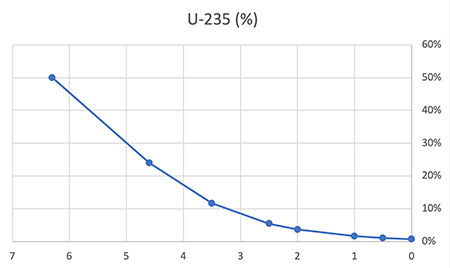
Cool question! And, while there’s some calculation that has to go into coming up with an answer, we can understand that answer without needing to get really into the equations. And it all starts with remembering that the half-lives of U-235 and U-238 are different – 704 million years and 4.47 billion years respectively. This means that our planet is about one U-238 half-life old and more than 6 U-235 half-lives old. Or, put another way, at the time our Earth formed it had twice as many U-238 atoms as exist today, and 64 times as many atoms of U-235; crunching the numbers, U-235 was about a quarter of all the uranium atoms on Earth when our planet first formed. That’s not only enough to sustain a chain reaction without enrichment, it falls into today’s category of highly enriched uranium (in which U-235 is greater than 20% of the total). The last time a light-water reactor could have produced energy using natural uranium was about 500 million years ago and when the Oklo reactor was operating (about 2 billion years ago) natural uranium contained about 3 ½% U-235 – within the range of enrichments used by today’s power reactors. But for all its age, there was never a time when Earth had as much U-235 as it had U-238.
That does, however, bring up some interesting additional questions: Where did the uranium form and how did it get into the Earth come to mind.
Going way back to the beginning of our universe, in the Big Bang some of the lightest elements in the universe – hydrogen, helium, and traces of lithium were formed. The hydrogen and helium formed gas clouds and stars, and the stars were (and are) powered by hydrogen fusion. Hydrogen atoms fuse to form helium, three helium atoms fuse to form carbon, and further fusions over the course of a star’s life form atoms and elements that are heavier still – all the way to iron. Each of these light-element fusions releases energy, but once iron is produced the energy release stops; fusing iron actually absorbs energy and, when this happens, the outer layers of the star collapse onto the core and then rebound off the core and blast into space in a supernova. The amount of energy released is phenomenal – supernovae can be seen across the universe – and the heavier atoms will fuse, forming atoms as heavy as tungsten, gold, lead, uranium, plutonium, and heavier.
Supernovae tend to produce more lighter atoms than heavier ones; there are about 1.65 U-235 atoms formed for every atom of U-238. Using this, and the difference in half-lives of these two isotopes we can calculate that the uranium on Earth might have been formed as many as 6.5 billion years ago if a single supernova was responsible for all of our uranium. This is a little simplistic, though; in reality there might have been as many as ten supernovae that contributed uranium atoms to the solar nebular – the cloud of gas and dust from which the Earth formed, some as recently as 200 million years ago, some as much as six billion years ago, and others of intermediate age. The uranium from each of these explosions mixed together in the solar nebula, which collapsed to form the Sun and planets about 4.6 billion years ago.
There’s no way to know for sure if the solar nebula was homogeneous and well-mixed or if different parts had different concentrations of uranium; for that matter, it’s possible that the shock waves from the various supernovae struck the solar nebula in different locations and at different times and that the solar nebula was never perfectly mixed; at present, however, we simply don’t have enough samples from enough planets, asteroids, meteors, and comets to reconstruct those fine details.
As far as uranium goes – where we started – let’s give a quick recap:
- Uranium is produced in supernovae, which produce about 1.65 times as much U-235 as they do U-238, with a U-235 enrichment of about 63% or so.
- Whatever the uranium enrichment in the primordial solar nebula, when Earth first formed about 24% of the planet’s uranium was U-235.
- The Oklo reactor, which operated about two billion years ago, likely ran on uranium enriched to about 3.7% U-235.
- By 500 million years ago, U-235 concentrations had dropped to about 1%; the lowest concentration that can sustain fission without using heavy water or graphite as a moderator.
- And today’s natural U-235 concentration of 0.72% can’t sustain a chain reaction without the help of those special materials for moderators.