

Good morning, Doc! I’m watching For All Mankind and they’re flying a “nuclear rocket.” Is this for real? How does that work? And how come we don’t have one today?
Let’s try a thought experiment…picture yourself standing on a skating rink, maybe next to a big bruiser of a hockey player. Perhaps having a lapse in judgement you give him a mighty shove; he drifts off away from you and you start sliding across the ice in the opposite direction. Newton figured this out centuries ago; his Third Law states (roughly speaking) that “For every action there is an equal and opposite reaction.” And Newton’s Third Law is what makes rockets work – shoot material (usually combusted rocket fuel) out the back of the rocket at a very high speed and the rocket will move in the other direction. The more material you eject and the faster it’s moving, the better acceleration you’ll get.
Today’s rockets are primarily chemically fueled – when the fuel burns, turning from liquid into gas, it expands in volume by a factor of more than 1000 and, on top of that, the combustion creates energy that heats up the fuel by nearly 3000 degrees (F) – from a cryogenic liquid to a superheated gas. This heat causes the exhaust gases to expand even more and the rocket speeds up even more.
Broadly speaking, that’s how a chemical rocket works. But you asked about a nuclear rocket. And would you believe me when I write that nuclear rockets operate pretty much the same way, just without the need to burn anything? Instead, the energy from nuclear fission heats a cryogenic liquid to a temperature of a few thousand degrees (F), causing it to expand and shoot out the back of the spacecraft, propelling the craft in the opposite direction. Easy-peasy! Well…except for some of the details – details that make the difference between, say, the combusting material in a campfire and a rocket launch. But let’s go back a bit and talk about where this idea came from and how it evolved over the years instead – it’s got some surprises!
Believe it or not, the first thoughts of nuclear-powered spacecraft date back to the Manhattan Project; in the mid-1940s two Manhattan Project scientists started wondering about using controlled nuclear explosions to launch and power rockets – an idea that continues to have adherents today, albeit not many given the reluctance of many to ride in a ship powered by thousands of tiny little thermonuclear explosives.
Over the next decade ideas of nuclear rocket propulsion matured, settling on using very high-temperature nuclear reactors to heat the propellant; several designs were investigated, including the NERVA rocket mentioned in the show. The first of these, KIWI, was developed under a program called Project Rover, run by Los Alamos National Laboratory (the birthplace of nuclear weapons). Interestingly, KIWI used a type of fuel that’s slated for use in some kinds of small modular reactors- tiny uranium spheres embedded in a graphite matrix. The first KIWI test, in 1959, reached a gas temperature of more than 4000 degrees F and produced 70 MW of thermal energy.
KIWI was followed by the 1961 NERVA engine followed by Phoebus, which cranked out a whopping 4000 MW of thermal power (equivalent to about 1300 MW of electrical power). When the American nuclear rocket programs were cancelled in 1973 more than 20 engines had been tested, showing the rockets to be powerful enough to be useful and to be many times more efficient than comparable chemical rockets. I’ve read some first-hand accounts of some of the nuclear rocket engine tests and I’ve got to say I’m sorry they all came before my time – some of the stories include the roar of the rockets as well as the sight of chunks of shielding and engine parts shooting into the air – that’s something I really wish I could’ve seen! Especially the destructive test of the Kiwi engine in 1965….
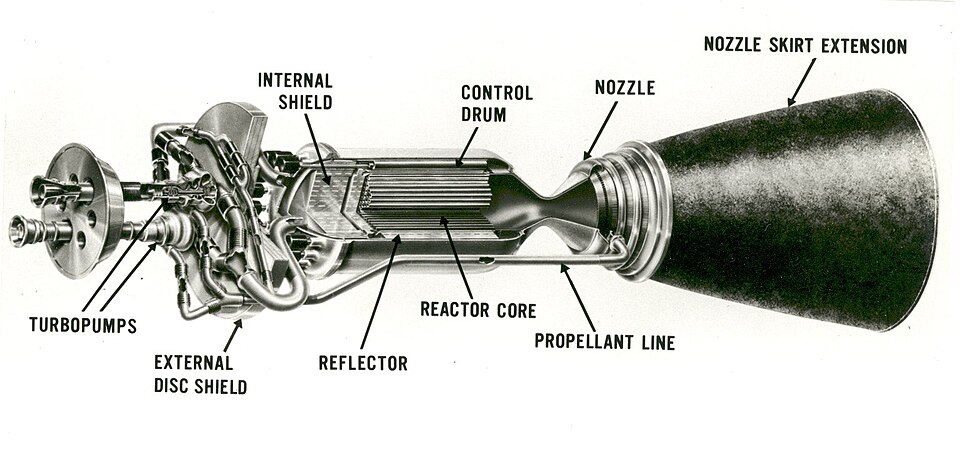
Since 1973 work on nuclear and radiological rocket engines has continued – Am-242m has been considered owing to its very high likelihood to fission when bombarded by neutrons, and radioactive fission fragments have been suggested as well, using them to heat the propulsion gas. And with renewed interest in traveling to Mars, among other long-duration space flights, it’s no surprise that NASA is once again looking into nuclear rockets to help stave off the impact of low gravity. And in 1925, NASA was told to spend as much as $110 million on spaceborne reactors. And that doesn’t even get into what the Russians, Brits, and other nations have done.
So – yes! NASA and a number of other nations have looked into nuclear rocket propulsion. At the moment it seems safe to say that it looks promising, but not as well-tested as we’d like before people’s lives depend on their working near-perfectly.