

Yeah – with all we’ve heard about reactor melt-downs and what happened at Three Mile Island and Fukushima I can understand your reluctance to put a lot of credence in the idea of a meltdown-proof reactor. And, frankly, if you heat anything up to a high enough temperature it’s going to melt; heat it up more and it’ll vaporize. But if the melting point of the fuel is higher than any temperature the fuel is likely to be able to reach even under extreme conditions then the fuel is effectively meltdown-proof. This can be done through careful selection of materials used to make the fuel or through clever engineering of the reactor plant, or both. Let’s concentrate on the fuel since I wrote about passive safety systems a little while back.
Graphite melts at just under 4000 C (nearly 7000 F), which is in the ballpark of temperatures found at the surface of the Sun. So if the uranium fuel pellets are wrapped in graphite, even if the fuel pellets melt the graphite will retain its integrity, continuing to safely contain the fuel and the radioactivity produced during fission. With a melting point of 3400 C (6200 F), tungsten is also a good material to use, but graphite is less expensive, lighter, and has better properties for use in a reactor core.
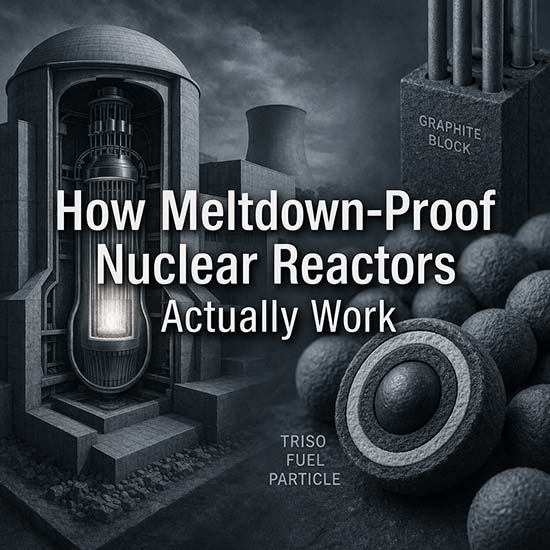
One way to use graphite in reactor fuel construction is in what’s called TRISO (TRIstructural ISOtropic) fuel. TRISO fuel particles are tiny – about the size of a poppyseed – and are made of a speck of uranium fuel surrounded by ceramic and graphite. The particles can be loaded into pellets or into graphite spheres that, themselves, can then be loaded into fuel assemblies or reactor cores, depending on the type of reactor; for “pebble-bed” reactors the TRISO particle-filled graphite spheres are loaded into the reactor vessel while prismatic fuel, made by loading the TRISO particles into channels in graphite blocks, is itself loaded into high-temperature gas-cooled reactor cores. In either configuration the high melting point of the graphite and the ceramic fuel particles contained within will resist melting at any temperatures the core is likely to achieve.
There’s more to reactor fuel than fissioning and not melting. The materials that make up the fuel shouldn’t absorb neutrons, for example (neutron absorbers are called “poisons”). And it should not only contain the fission products, but also the pressure from the gases that are produced by fission – isotopes of xenon and krypton (fission product noble gases), volatile elements such as iodine and cesium, and the like. Older fuels couldn’t always hold these pressures, causing the fuel to split, swell, or fracture, losing its integrity and releasing fission products into the reactor coolant.
The fuel that’s in most nuclear reactors today is made of uranium oxide fuel pellets that are clad in a zirconium alloy; the fuel pellets are placed in tubes made of a slightly different zirconium alloy and these tubes are placed into a grid pattern to form a fuel assembly. The reason for using zirconium is that it’s highly resistant to corrosion so, even if it’s submerged in seawater, the zirconium will continue to stay intact. The biggest problem with zirconium is that at very high temperatures it can catalyze the release of hydrogen from water, creating a hydrogen bubble that can explode. Most of the radioactivity released by the Three Mile Island accident left the plant when the operators decided to deliberately vent hydrogen to reduce the risk of an explosion; the fission product gases and the volatile iodine and cesium nuclides were vented at the same time. And at Fukushima, there were multiple explosions from accumulated hydrogen before the accident was brought under control. The graphite that plays so important a role in the meltdown-proof fuels, on the other hand, won’t generate hydrogen, which is nice; even better is that graphite doesn’t absorb neutrons very easily.
The biggest potential issue with graphite is that it’s carbon and, as such, it can catch fire and burn, as happened to the graphite in the core at the Chernobyl reactor plant. Having said that, this is less likely to happen in one of the newer reactors due to the plant design, and even if it does occur there are still multiple non-flammable protective layers that will continue to protect the fuel particles and keep them from releasing their radioactivity into the environment.
The bottom line is that, while no fuel design is perfect, the TRISO fuel – whether used in a pebble bed or a high-temperature gas-cooled reactor – is some very rugged stuff that’s going to keep the fuel safe through worse conditions than were seen at Three Mile Island, Fukushima, or even Chernobyl. That’s pretty good.