
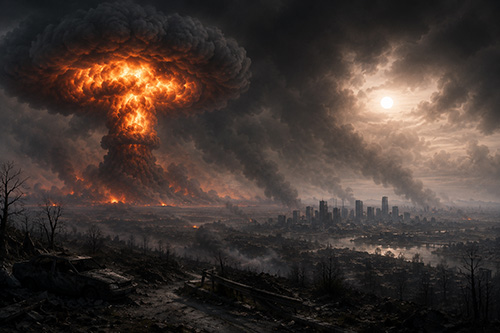

Hi, Doc! So what’s the deal with “nuclear winter”? Seems it comes up every now and again; some scientists say it can kill billions of people; some say the dinosaurs died from the same sort of thing following an asteroid impact. So what do I need to know about it? And should I stock up on firewood? Thanks!
On April 5, 1815 a volcano – Mount Tambora – in what is now Indonesia blasted itself apart in the most violent volcanic eruption in recorded human history. Close to 10 cubic miles of rock, much in the form of dust, was blasted into the atmosphere, along with massive volumes of sulfur dioxide, spreading to cover most of our planet, attenuating the amount of sunlight reaching the surface. So much so that 1816 was known as The Year Without a Summer; temperatures dropped, extreme weather was more common, and harvests failed around the world.
Take that and multiply by…well, we’re not quite sure to be honest; it would depend on the number of nuclear weapons and their yield, where they were detonated, the size of the mass fires and how much soot they produced, how high in the atmosphere the debris is carried, and on and on. But the general principle is the same – shoot enough stuff into the atmosphere and it shadows the Earth and temperatures start to fall; put more in the atmosphere and, between the reduction in sunlight and the cooler temperatures, plants start to die.
Asteroid impacts can do the same – some scientists speculate that the dinosaurs were killed by a combination of massive fires ignited by red-hot debris reentering the atmosphere after having been blasted into space by the impact, followed by plummeting temperatures caused by the injection of 15,000 – 20,000 cubic miles of rock dust along with billions of tons of sulfur dioxide. The fires, caused by the heat of debris blasted into space and falling back to the surface, created soot and smoke; sulfur dioxide condenses to form reflective crystals; as with the debris from nuclear explosions and volcanoes, all of this blocks the sunlight.
So here’s the question – how much global darkening ensues per megaton of nuclear yield? And the answer is that we just don’t know…or maybe ”it depends” is more accurate. The thing is, there are too many variables to generalize – wood structures will produce more smoke than stone or steel, business and government districts are likely to contain more paper than residential areas, the drier vegetation of late summer is more likely to burn than the hydrated spring trees and crops – and all of this affects the amount of smoke and soot produced by the mass fires ignited by nuclear detonations. And get this – if the blasts are at a sufficient altitude that the fireball doesn’t touch the ground the fires, cold, and crop failures will be far deadlier than the radiation.
This is where the questions in the second paragraph come into play – to figure out what the environmental impacts of a nuclear war, a volcanic eruption, or an asteroid impact we need to make a LOT of assumptions just to generate data to feed into modeling software, more assumptions go into setting up and running the models, and still more assumptions come into play when trying to figure out what the results mean. Since the assumptions are so important, it might be worth talking about what they are and where they come from. Let’s take a look at a few, starting with an easy one – the altitude at which nuclear weapons might detonate.
- The bombs dropped during World War II were detonated between 1500-2000 feet above the ground in order to maximize the destruction from the blast wave. At this altitude the fireball never touched the ground and the radioactive fission fragments drifted downwind with the prevailing winds, ending up deposited over a large swath of land and ocean and producing only a small radiation dose (some people got a high dose of radiation from the detonation itself, but fallout produced very little dose). Based on this, we might make a few assumptions:
- Nuclear attacks made by nuclear-capable nations are likely to lead to multiple air bursts like the attacks in 1945, with greater blast damage and fires, but less radioactive fallout.
- Attacks made by terrorist groups are thought likely to involve surface bursts, with lower levels of blast and thermal effects but more radioactive fallout.
This means that an attack made by a nation is likely to produce higher levels of dust, smoke, and soot with a correspondingly greater environmental impact compared to a terrorist attack. But now things get more interesting – knowing that (for example) the radius of a mass fire might be, say, ½ mile, and that buildings will collapse to about the same distance is a good start. But how many buildings will be within that distance of the site of an attack and what are they made of – how much dust will they produce? And how much flammable material – wood, paper, asphalt, plastic, and such – will be within that radius and what fraction of that material will ignite, producing how much soot and smoke? We can study cities around the world and guess at each of these – these guesses are another set of assumptions – and the better our guesses, the more accurate will be the data we enter into our models.
And, speaking of models, model is just a set of calculations that are used to help understand what might happen under various conditions; they can be fairly simple or fiendishly complex. Say, for example, I assume I’ll be putting $500 into my savings account every two weeks and I want to calculate how much I’ll have in 40 years. The simplest model would consider only the amount I save – $13,000 a year for 40 years comes out to $520,000, assuming that the account earns no interest. The next simplest model would be to assume the account earns a constant interest rate – say, 1% annually.
A still more complex model might make additional assumptions about past interest rates, anticipated future changes in interest rates, inflation, and other factors. And to cover all the bases, for each assumption we’d want to guess a high number (say, 10%), a low number (e.g. 1%), and a most-likely value (maybe 5%). This sort of sensitivity analysis can be used on each variable and various combinations of variables; this makes the models harder to run, but gives a more believable best- and worst-case numbers.
We can do the same sort of thing to develop sets of assumptions about dust, soot, and smoke production from a nuclear attack as well as how they’ll disperse around the world and how this will affect the climate, food production, and number of resulting deaths. And let me add that the hardest part of all of this isn’t coming up with a number for each of these assumptions – the hardest part is coming up with an honest number; one that doesn’t reflect your biases.
Finally, to put all of this together, nuclear (and volcanic and impact) winter predictions are based on complex models using a ton of assumptions. This can make them more accurate, but each assumption makes the model more liable to being affected by the biases of the people running them. For this reason, I feel comfortable agreeing that nuclear explosions are likely to affect the climate if there are enough of them and they’re powerful enough, and I’m even willing to agree that it’s more likely than not that the most likely effect will be to lower temperatures. Beyond that, all I can say is that the effects might lead to a nuclear winter scenario – but that there are a lot of other possibilities as well.