

Solar storms and holiday travel
Doc, I saw this thing in the news today and I flew home for Thanksgiving last weekend, when they were having some big solar storms that reached the ground. Do I need to worry? Are there any anti-radiation meds I can take? It was a long flight (Anchorage to LA)!
Let’s start off with the numbers. You didn’t give any dates so I entered your dates of travel for November 11, returning November 30 – the reason for the early departure is to try to include the big solar flare that hit Earth that day. There are a few online programs you can use – I used one called the Sievert system, but it doesn’t appear to use actual data from the date(s) in question so much as average data for various flight paths. So let’s try it this way.
- The Sievert system showed an estimated dose of about 1 mrem for the route you took and the story you linked to noted that dose rates at 40,000 feet maxed out at about 10 times the normal background levels. So the most dose you would have received on your flight would be about 10 mrem.
- This is about what you’d get from a single chest x-ray or from about natural radiation in a week and a half; it’s about half of the dose I received flying from NYC to Tokyo when I visited my daughter in 2019.
- The most dose I picked up in a short period of time was 250 mrem while working in the reactor compartment on my submarine – which was well within legal dose limits.
- And none of this (1 mrem, 10 mrem, or even 250 mrem) is going to harm anyone.
So the most important thing is don’t sweat your holiday travel! It didn’t put you at risk, and your family was (hopefully!) happy to spend some time with you. Now, let’s talk a little about why the Sun is so active and what a very active Sun can do to us here on Earth.
The Sun spews out more than four million tons of mass every second – over one hundred trillion tons every year – mostly in the form of protons and electrons with a soupçon of the nuclei of helium atoms; this is the Solar wind. Most of these particles coast along at a few hundred kilometers per second, taking several days to reach the Earth. But every now and again the Sun will shoot out solar flares or even a chunk of its corona (a coronal mass ejection) – massive amounts of particles flying outwards at huge velocities and with enormous energies. And if our Earth happens to be in the path of these particles they’ll slice through our magnetic field, slam into the atmosphere, and initiate cascades of secondary radiations (both particles and rays) that can penetrate all the way to sea level – and raising radiation levels in the atmosphere through which they’re passing at all altitudes. Extreme events can not only raise radiation levels in the atmosphere, but can affect satellites in orbit, mess with the computers on aircraft, and can even induce electrical currents in phone and electrical lines on the surface of our planet.
The biggest solar flare that we know of to strike the Earth hit in 1859; it’s called the Carrington Event. The material ejected from the Sun was spit out at such high velocities that it reached the Earth in less than a day (compared to the typical several days), and the ionization they produced caused electrical current overloads on telegraph lines that caused a number of fires as well as creating aurorae in both Northern and Southern hemispheres that were visible nearly to the equator; aurorae that were bright enough to read by at night.
I’m not aware of anyone who’s tried to determine the radiation dose from this event, but there has been some work on the mean time between solar events that could cause various levels of radiation exposure at the Earth’s surface. Work by Keran O’Brien, a physicist studying solar radiation, shows that we can expect a solar flare that could give us a sea-level radiation dose of 10 rem about once every 6000 years, and a potentially fatal dose of 500 rem about every eight million years. What this means is that, while it’s entirely possible that a huge solar flare or coronal mass ejection might cause dangerous levels at the bottom of our atmosphere…but it doesn’t happen very often, and none of us are likely to experience it.
The typical solar flare puts out a lot of energy – equivalent to about one billion nuclear weapons. But every now and again the Sun will unleash flares with a hundred times as much energy – and every few to several million years the Sun will let loose with a flare capable of inducing radiation sickness at sea level. But even more rare are the super-flares that are capable of killing most of the plants and animals on the surface of our planet (although critters that live underground or underwater have a pretty good chance of survival); flares like this might happen only a handful of times over the planet’s history; considering that life only emerged onto land about 400 million years ago, terrestrial organisms might not have been exposed to such levels of cosmic radiation over the history of terrestrial life. What’s sort of cool is that we’ve got evidence that this sort of thing is not uncommon among other sunlike stars in our galaxy.
Bringing things back to Earth, these large solar flares can affect more than our health – they can also affect our technology. I already mentioned the Carrington Event and the problems it induced in the nation’s telegraph system; today’s electrical and electronic gear is a lot more fragile and susceptible to electromagnetic fields, and the systems on satellites and aircraft can be more sensitive still. In fact, we’ve seen this in both air and space – satellites knocked offline and aircraft grounded (or suffering in-flight computer errors) by large solar flares.
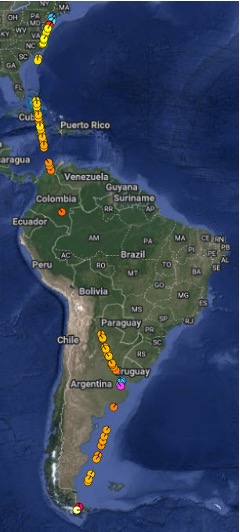
So…sure, huge solar flares can add a little spice to our flying experience – but even though we know it’s possible to receive a harmful dose of radiation, it’s very unlikely to happen. For what it’s worth, I’m not planning on changing any travel plans on account of this story. Oh – and if you’re intrigued (but not worried), check out the Cosmic On Air website! The guy who runs it is looking for people to carry radiation detectors with them when they fly, hoping to catch the radiation profile of a solar flare or coronal mass ejection (CME) when it slams into our atmosphere. There’s also the Safecast project, which collects data from people all over the world – in the air or on the ground. I’ve been participating in both of these for over a year now; saving and uploading the data is pretty straightforward…and it can make some nice maps!