
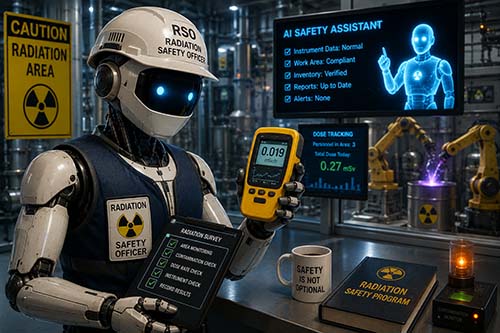

Hi, Dr. Zoomie – I’m curious. My company says they’re going to start using AI. As an RSO, what can AI do and what can’t it do? Do I need to worry that AI will take my job?
Maybe a bit, but likely not completely. With luck, AI will make your RSO job a bit simpler and less annoying, but I’m pretty sure it’s a decade or so from threatening to do your entire job…so don’t hang up your Geiger counter just yet. Here’s what I think might happen.
There are some parts of your radiation safety program that cannot – yet – be fully delegated to AI…radiation and contamination surveys fall into this category. An AI system can monitor installed radiation instruments, looking for unexpected readings, but there is not yet a mobile AI-powered radiation instrument that can, say, survey around an irradiator that was flooded during a hurricane or jostled by an earthquake. Similarly, an AI system can run a smear wipe counter, log the results, calculate the amount of contamination present – but it can’t look at a lab or workbench, determine where to check for contamination, or take the wipes. So an AI system can take readings from fixed instruments and it can help you to track your radiation and contamination results, as long as everything is routine. But in the face of the unexpected you will still need to be the one taking wipes and planning and performing the radiation surveys.
Responding to the unexpected is another area in which you’re likely to remain needed for a while. We can program, say, a response flowchart to cover many problems, but we can’t think of every possibility and how they might all play out. People are good at improvisation – computers (so far) are not…and they’re not very good at responding to emergencies. For example, say a person falls down a flight of stairs and sustains injuries while carrying radioactive liquid – your AI system might be able to walk you through a flowchart, but it’s not likely to be able to compensate if the progress of the response varies from it. As one example – say the flowchart covers a broken arm or leg, but the worker broke a rib or suffered a concussion? Similarly, an AI won’t be able to fight a fire in a “hot” lab or stabilize a leaking carboy filled with liquid scintillation cocktail or package radioactive waste into drums for disposal – but it ought to be able to do a great job of doing all the calculations, writing a report, and notifying the regulators.
These are the sorts of things that you’re likely to continue needing to do, at least for a while – the work that requires the ability to adapt to changing circumstances, working with the unexpected, and doing a variety of physical tasks. As one specific example of this, I remember coming in to work one day to be told that our freezer had broken and the contents had thawed over a hot August weekend. The problem was that the freezer was about as big as my living room and it was stuffed with frozen (or, rather, with the no-longer-frozen) carcasses of a decade’s worth of laboratory animals that had been injected with radioactive tracers for various research projects over the years; they had never quite been cleared out by my predecessors. After persuading the Facilities mechanics to inject some refrigerant into the system to get the freezer cooled down again, I headed over with one of my techs and we inspected the remains, came up with a plan to characterize the amount of radioactivity in each of them, and sorted them into various categories for disposal. Once everything was frozen again, we moved them around to permit surveying for contamination and eventually packaged them up for shipping or incineration. It’s hard to see an AI system doing much of that, and certainly none of the physical work …although here, too, it could have done a great job of compiling all of the survey results, transcribing narrative reports into a final report, and communicating with regulators and the Radiation Safety Committee.
I’d hazard a guess that this is what we’ll be able to expect from AI for some years to come – we humans will continue to make plans, to do most of the physical work, tackle the complex jobs that require judgement and the ability to tackle novel circumstances, and the like, all while our AI assistants will chug along in the lab, office, and background to help us with the dreary calculations and report-writing. And in other areas – ones that result in producing new knowledge and otherwise venturing into the unknown – humans are likely to remain necessary for some time to come. So not to worry about an AI replacement!