


Hey Doc – on a recent post you mentioned a deice called a Troxler gauge could be used to measure soil density and moisture content. How’s that work?
These gauges are actually pretty slick – I’ve used soil density gauges a number of times and took a three-day class on how to use both types, as well as working for a geotechnical consulting firm that had a bunch of Troxler gauges. Soil density is the one I know best, and it’s also pretty straightforward.
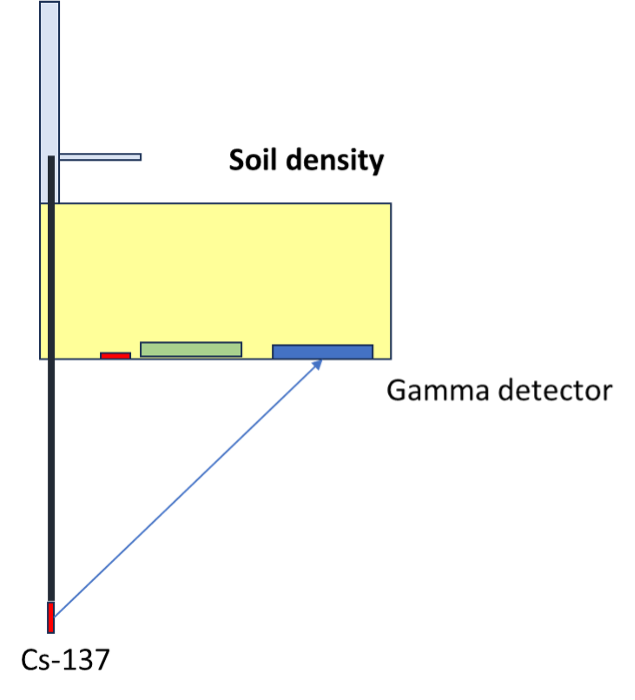
The gauge itself is pretty simple – there’s a Cs-137 source at the end of a rod. To use it, the technician will push the rod into the soil as far as possible. The radiation from the Cs-137 source passes through soil on its way to the gamma detector. The soil attenuates the radiation and causes the dose rate or count rate to drop; using a fairly simple calculation comparing what the measurement would be without the soil and what’s actually measured, a small computer inside the gauge calculates how much material is in between the source and the detector. The weaker the signal, the more material the radiation had to pass through. And since the distance between the source and the gamma detector never changes, the user can know how dense the soil is; information that can be used to tell a geotechnical engineer if the soil can support a building (and, if so, how heavy a structure), a freeway, an off-ramp, etc. For radiation safety, the source is housed in a shield when it’s retracted into the body of the gauge.
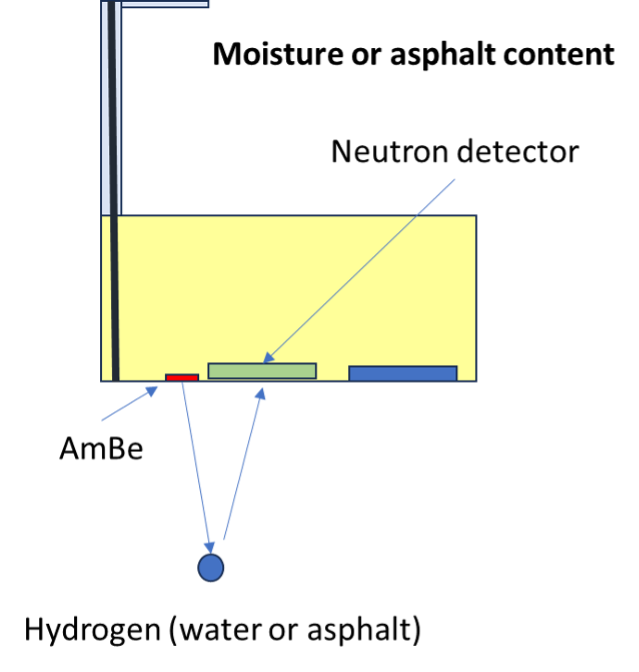
These gauges are little less direct, but no less effective. The principle here is that neutrons, when they strike an atom of hydrogen, are more likely to bounce back (reflect) in the direction they came from than if they strike an atom of any other element. So for a given source, the more neutrons that are reflected back into the neutron detector, the more hydrogen atoms there are in the soil. And, since two-thirds of the atoms in a water molecule are hydrogen (H2O), the gauge can calculate the amount of moisture in the soil by looking at the number of neutrons that are reflected back to be detected.
While these gauges are most-often used to determine moisture content, they can be calibrated to determine how much hydrocarbon is present in, say, the asphalt used to pave roads or in the tar used to seal roofs.
Either way, the principle is the same – the higher the neutron count rate, the more hydrogen is present in the material beneath the gauge and the more moisture is in the soil or the more hydrocarbon is in the tar or asphalt.
For radiation safety – both of these sources are stored inside of shielding to protect people from radiation when the sources are not in use. And when the gauge is in use it’s placed on the ground and the soil shields the radiation given off by the source(s). When it’s not in use it should be stored in a secure location to keep it from being stolen, and that location needs to be surveyed for radiation levels a few times annually. And one more caution – make sure the gauge is secured in the bed of your pickup if you bring it to and from the jobsite that way. You really don’t want your gauge to slide or bounce out of your truck when you’re driving on bad roads or across fields to get to a construction site. Not only that, but if you put it in the bed of the pickup when you take a lunch break, you don’t want someone to grab it as they’re passing by. On the bright side, the gauge and case weighs about 80 pounds, so if someone does manage to get it out of the truck they’re not going to be running with it.