
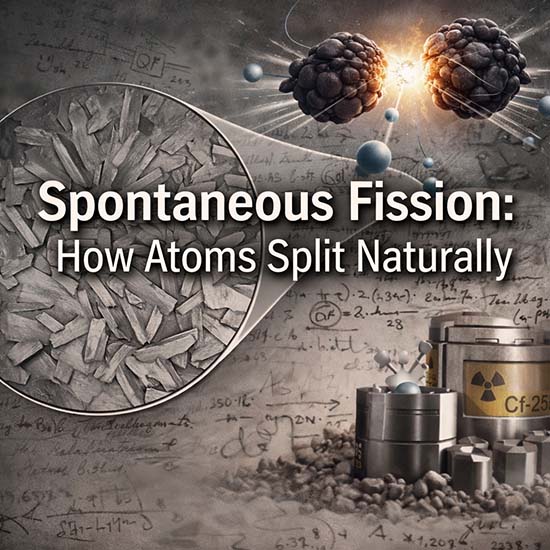

Dr. Zoomie – so I know that we can make uranium fission and I know there was a natural fission reactor, but what’s this I hear about some atoms simply splitting on their own? What’s that about? And is useful at all, or just something interesting to know about?
Ah – spontaneous fission – one of my favorite types of radioactive decay. And, yes, I know that makes me sound incredibly nerdy, but I can live with that.
Of the four fundamental forces in the universe (gravity, electromagnetism, strong and weak nuclear forces), the strong force is what holds atomic nuclei together, and the strong force acts only over the very tiniest distances – the strong force can reach about as far as the other side of an atom’s nucleus, but not much further. In fact, if the atom’s a large one, the strong force from a proton or neutron on one side of the nucleus can’t even reach across to the other side. So as atoms become physically larger, the strong force exerts less and less of a hold across the entire nucleus – at the same time, increasing the number of protons increases the amount of electromagnetic repulsion trying to force the nuclei apart.
When the nucleus holds more than about 90 protons the strong force starts to lose the battle to hold the nucleus together and atoms can start to simply fall apart – or to be more technical, they begin to fission spontaneously, producing two fission products, a few neutrons, and some gamma radiation. One way nuclear scientists thought of the nucleus in the 1940s was as a liquid drop, with the strong force acting like the surface tension that holds a drop of water together until the sheer size and weight of the drop (or of the atom) is too much, at which point the atom (or the drop of water) simply falls apart.
When I was in the Navy’s Nuclear Power School, we were taught that uranium (specifically U-238) would spontaneously fission, as well as transuranic nuclides such as Pu-240; in fact, neutrons from these atoms were always present in the reactor core, even with the control rods completely inserted into the core. As an aside, it’s the spontaneous fission of Pu-240 that threatened to stymie early attempts to build nuclear weapons fueled with plutonium – the same process used to produce Pu-239 in the reactor core will also produce the spontaneously fissioning Pu-240. The problem is the pesky neutrons – in a gun-type weapon, as the pieces of plutonium approach each other, the neutrons from spontaneous fission start to strike the other piece plutonium, which begins to fission. This can actually create enough energy to blow the two pieces of plutonium apart before the weapon can fully detonate. So I guess those are two things that spontaneous fission can do – it can provide neutrons to help start up your nuclear reactor, or it can provide too many neutrons to prevent your nuclear weapon from functioning properly.
When the atoms get even larger the rate of spontaneous fission increases and with a really large atom such as Cf-252 (Cf is californium) then even a tiny bit (a few micrograms) will give off enough neutrons to use as a neutron source. Scientists will use Cf-252 to produce neutrons for their research and, in the geotechnical and drilling industry, the neutrons from spontaneous fission can be used to determine the moisture content of soils or to learn how much hydrogen (found in water and hydrocarbons) might be in the rocks surrounding your radiation source and neutron detector.
So that’s something else that spontaneous fission’s good for – making neutrons for geotechnical, geological, or industrial purposes. But there’s another use that’s even more fun – using spontaneous fission to help date geologic events. This is really cool – and this is how it works.
Picture a mineral crystal – maybe a crystal of the mineral zircon. Ziron crystals almost always contain traces of uranium and most uranium atoms are U-238, which usually decays by emitting an alpha particle, but every so often one will spontaneously fission. – one spontaneous fission for about every 2 million alpha decays. When that happens, it releases a lot of energy and that energy goes into shooting the two fission products and neutrons out from where the original atom had been. Remember – the uranium atom is contained inside a zircon crystal, which is made of a variety of atoms arranged in a regular three-dimensional pattern. As the fission fragments go plowing through this array they slam into the atoms, knocking them out their position in the lattice – the image in my mind is of a bowling ball smashing through a grid of pins, knocking down the ones along its path and leaving a visible…call it a scar…showing where it had passed. And in the mineral crystal, the fission fragments also leave a sort of scar; in this case in the form of atoms knocked out of place. And if we could see that scar – and others like it – we could measure the amount of uranium in the mineral crystal and calculate the crystal’s age.
It turns out we can find a way to make that scar – and the others like it – visible. When the fission products slam through the crystal, knocking atoms hither and yon, it weakens the structure and makes it more susceptible to acids. So what an enterprising isotope geologist can do is to cut the crystal and bathe the cut face in acid; the acid will eat away at the damaged parts of crystal more than the undamaged parts, leaving a track that can be seen through a microscope. Counting these fission tracks tells us how many uranium atoms fissioned on that surface; a little math can reveal how many uranium atoms in the crystal fissioned. And when the scientists measure the amount of uranium in the crystal they can calculate the age of the crystal. This is called fission track dating.
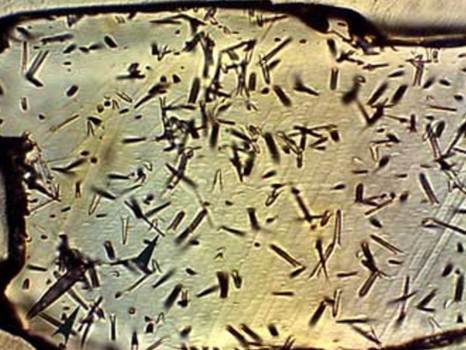
Here’s the thing, if you heat the crystal up to the right temperature the fission tracks will anneal – they’ll repair themselves, effectively resetting the “clock” that the number of tracks represent. Thus, counting the fission tracks doesn’t really tell us how old the crystal is so much as telling us how long ago the crystal was last at the annealing temperature. This sounds like a bit of a setback – what good is it, for example, to only be able to figure out how long ago a rock was last at a temperature of 230-250 C (the annealing temperature for zircons).
Several decades back researchers were doing fission track dating of rocks in the Alps and they noticed that, as they went deeper into the rocks, the ages were younger and younger – the oldest dates were at the tops of the mountains with younger-dated rocks more deeply buried. Realizing that the temperature of the rocks increases as we go deeper into the Earth (the geothermal gradient) the geologists realized that what they’d found was a way to tell when each layer of rock had last been buried deeply enough to be at the annealing temperature; with these dates they could tell how quickly the Alps were being pushed upwards by tectonic forces.
Is this information useful? If you’re a historical geologist or the right flavor of geophysicist then it is – it helps you to better understand the forces and dynamics at work when mountains are raised. And if you’re an economic geologist then it can give you a better idea of how the rocks and the structures they form have evolved over time, which just might help you to understand where there might be mineral deposits that can be mined. So – yes – this information is useful!
And that’s about all I can think of for spontaneous fission. To me, it’s a cool process – the fact that it can sometimes be useful is a nice bonus.