
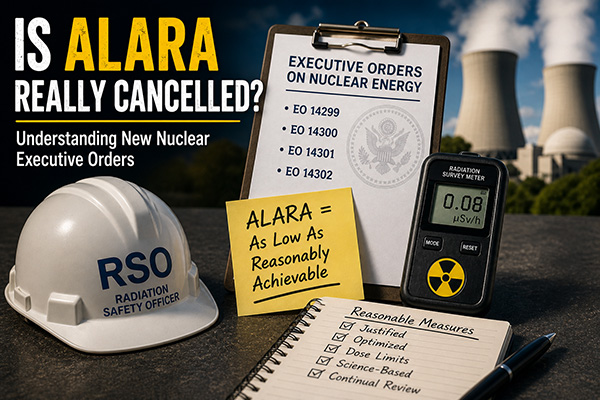

Hey Doc – what’s this I hear about ALARA being cancelled? Is that for real?
Ah – you’re talking about the President’s flurry of Executive Orders on nuclear energy and how they’re being interpreted! It’s a little more complicated than cancelling ALARA, but the way some agencies have been reacting it would be hard to figure that out. So let’s take a look to see what they actually read, how they’re being interpreted, and how it all affects all of us Radiation Safety Officers.
To start with, here are the four Executive Orders and where you can find them:
- EO 14299: Deploying Advanced Nuclear Reactor Technologies for National Security
- EO 14300: Ordering the Reform of the Nuclear Regulatory Commission
- EO 14301: Reforming Nuclear Reactor Testing at the Department of Energy
- EO 14302: Reinvigorating the Nuclear Industrial Base
Of these, it’s EO14300 that mentions ALARA, near the end in Section 5 (b), where it instructs the Nuclear Regulatory Commission (NRC) to “Adopt science-based radiation limits. In particular, the NRC shall reconsider reliance on the linear no-threshold (LNT) model for radiation exposure and the “as low as reasonably achievable” standard, which is predicated on LNT.” The thing is that this has been interpreted as instructing the elimination of ALARA as a concept – an interpretation that, honestly, seems wrong to me, and guaranteed to upset the maximum number of people, radiation safety professionals and members of the public alike.
I’ve written about the controversy regarding the risks of exposure to low doses of radiation and whether every bit of exposure might (or might not) carry with it some risk. There are some people who feel that even the slightest bit of radiation exposure poses a tiny extra risk, some who feel that there’s a threshold below which radiation causes no harm, and some variations on each. And this is all in the context of the ALARA principle – the principle that we should take all reasonable measures to keep radiation exposure as low as we can. I’ve been working in radiation safety for 45 years and I have practiced ALARA that entire time – while working with the reactor on my submarine, as Radiation Safety Officer at a university and hospital, in the North Dakota oilfields, and in many other settings. Please note – as a health physicist and scientist I feel there’s a threshold, below which there are no adverse health effects from radiation exposure. And yet, I don’t see the existence of a threshold to be inconsistent with the ALARA principle – what I can’t understand is how the author(s) of this Executive Order could have concluded that the ALARA principle can only be consistent with one of the possible models for response to radiation exposure.
To me, the crux of the issue is the word “reasonable.” Let’s start with something more familiar than radiation – let’s talk about driving. There’s a lot of evidence that wearing seatbelts can save lives – I’ve been in at least one accident in which a seatbelt certainly saved mine. Plus, they’re not very expensive – spending a small amount of money for something that demonstrably helps save lives seems to be a pretty reasonable thing to do.
But what about a different safety feature? For example, every now and again someone will drive a car into a body of water and, trapped inside, will drown. Some of these lives might be saved by installing an automatic floatation device in cars – something that would inflate automatically to float the car to the surface if it was driven into a lake or river. Why aren’t these as common as seatbelts – why aren’t they required too? Well, mainly because not many people drown due to automobile accidents – fewer than 50 annually. Considering that adding flotation devices would cost several thousand dollars for each vehicle, a high cost considering the small number of lives that might be saved. It just isn’t reasonable for the government to mandate adding so much to the cost of every vehicle, only a very small number of which might ever benefit from them.
But how about that anti-alien abduction safety feature! How much is reasonable to spend for a safety feature that will keep aliens from beaming you up to their spaceship from your car? Would you pay, say, $25,000 to avoid being abducted by aliens while driving? My guess is you probably wouldn’t – although you might be tempted to shell out $20 for insurance that pays out $10 million if you really are beamed up (although only if the aliens sign the claim form). It might be reasonable for some to pay a small amount to protect against a highly unlikely occurrence like being in a traffic accident – but is it reasonable to pay a lot to protect against a vanishingly small risk like an alien abduction? Not for the great majority of us, and it’s the same with radiation. Or, to put it another way, if the 100 mrem I receive each year isn’t shown to be a risk, how can it possibly be reasonable to spend money to try to reduce my dose even further?
Our epidemiological studies don’t show any ill effects from exposure to less than about 10 rem over a lifetime, or about 100 mrem in a year. Given this, how much money is it reasonable to spend to try to reduce public radiation exposure from, say, 100 mrem to 10 mrem annually? Well…I’m not sure about you, but I wouldn’t consider it reasonable to spend any money at all to reduce a safe level of radiation exposure to something lower. And that’s the beauty (in my opinion) of the ALARA concept – it doesn’t mean we need to blindly reduce radiation exposures ever-lower; it only calls on us to reduce exposures reasonably, and what’s “reasonable” can be adjusted along with our understanding of the basic science. And for me, in all four of the places I’ve served as RSO, this view of ALARA means I’d not need to change my practices nor my radiation safety program at all under the new Executive Orders.