

So, Dr. Zoomie – I hear about uranium mining but I don’t really know what it entails. How is uranium mined? And is there any way for me to visit a uranium mine? I’m just curious – and thanks!
Wow – I’ve got to admit that, as much as I’ve studied uranium geochemistry, read about uranium ore deposits, and even given training to uranium mining companies, I’ve never actually visited a uranium mine. So let me take a look to see what I can find – and thanks for asking!
A while later
Turns out there are a lot of different ways to mine uranium. Three of these (underground, open pit, and heap leaching mining) requires blasting and digging; the others (in-situ leaching, co-product or byproduct, heap leach mining, and seawater recovery) make more use of chemistry than explosives, but are also effective ways to get uranium out of the Earth. One comment that applies to all of these is that to be considered ore it’s not enough to simply have the mineral or metal of interest present – it’s got to be economically recoverable. For example, rock at the surface of the Earth with a low concentration of uranium is easy and inexpensive to dig up, but bringing it up from deep underground costs much, much more. So the same rock that’s an ore at the surface might not be an ore if it’s deeply buried if the cost of selling the uranium is lower than the cost of recovering and processing it.
Underground mining goes back thousands of years and it’s the picture that pops into the mind for most people when they think of mining; it’s the one with miners toiling away underground, digging tunnels to follow veins of ore, bringing the ore to the surface to have the mineral of interest (usually a metal) extracted and processed. Underground mining can be expensive and dangerous and is usually only economical for fairly rich mineral concentrations.
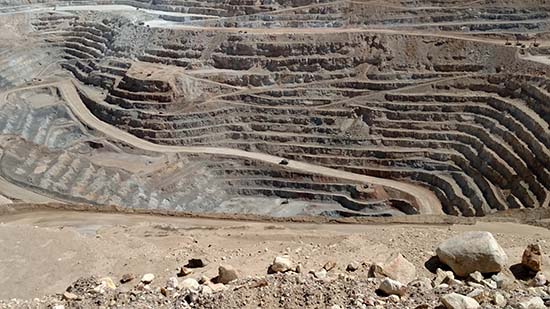
Open pit mining involves blasting or digging huge holes in the earth, scooping up the rubble, and processing it to remove the mineral or metal of interest. Open pit mining can be used for rich deposits (it’s possibly best-known for its use in coal mining, but it’s much more widely used than simply coal) but can also be a cost-effective way of producing large volumes of rock with low concentrations of minerals or metals for further processing.
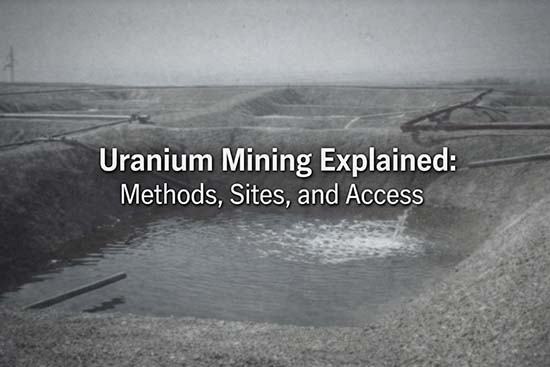
Heap leaching is more a method of extracting minerals or metals from the rubble produced by open pit mining; the extracted rock is crushed and pulverized, piled up in huge heaps, and a solvent is applied to the heaps, trickling through the pile into a catch basic or trough at the bottom for collection and processing.
In-situ leaching (also called “solution mining” doesn’t require bringing rock to the surface; instead, holes are drilled into a mineral- or metal-bearing rock formation; a solvent is pumped into one hole and pumped out of others, bringing the mineral or metal with it.
Co-product or byproduct recovery takes us back to the definition of “ore.” There are gold mines that are dug more than two miles deep into the Earth to access high-grade gold deposits. It turns out that many of these deposits also contain uranium; the concentrations are too low to make it worthwhile to dig that deep just for the uranium, but when the rock is already at the surface to extract the gold, removing the uranium is cheap and easy to do. It’s a great example of a metal that’s an ore at the surface, but not at depth.
Seawater recovery takes advantage of uranium’s solubility in water; you can think of it as solution mining in which the uranium has already been dissolved and just needs to be extracted from the solvent.
Although I haven’t visited a uranium mine, I’ve visited an open pit mine, a heap leaching operation, and a few old underground silver mines. The open pit mine was staggeringly huge – over a mile in diameter and maybe 1000 feet deep, and watching an acre of rock blasted to a depth of 35 feet in a half-second was pretty impressive (although the piles of rock piled up for heap leaching were somewhat less exciting). Sad to say, most of the other methods aren’t all that interesting; luckily, I’m not aware of any of the boring types of mines being available for tours. And this brings us to the second part of this post – where you might be able to visit an actual uranium mine.
Uranium mining in the US is concentrated in the West – Texas, New Mexico, Colorado, and neighboring states. Of these, the best place I know of to see photogenic uranium mines (i.e. not solution mining or heap leaching) is about an hour or so west of Albuquerque and a few hours from Santa Fe, near a town called Grants. In the area are a number of working uranium mines, the New Mexico Mining Museum, and the Uranium Energy Corporation has a facility along the way. The mining museum is easy enough to find and visit; the mines, not so much – and non-working mines might not be easy to find, nor safe to visit. To find out more about where you might able to visit an actual uranium mine or find outcrops of uranium-bearing rocks you might want to start with the Atomic Buggie website.