
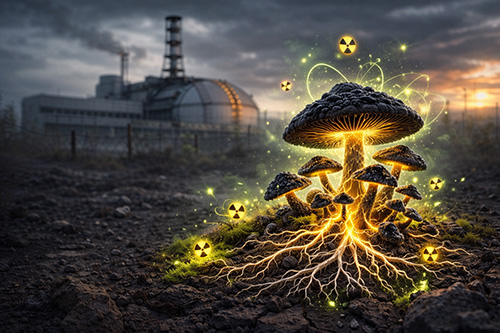

Radiation-munching fungus!?!
Hi, Dr. Zoomie – I read something about fungus that’s eating radiation at Chernobyl. Really? Isn’t that from a science fiction plot? I’m thinking Andromeda Strainmaybe.
Andromeda Strain…that’s reaching back a bit! I’ve got vague memories of seeing the posters when I was a kid in the early 1970s and I saw it the first time when I was in high school in the late 70s. Great movie, by the way – I liked it as much as the book; some aspects were even better (in my humble opinion). For those of you who haven’t seen the movie or read the book, the central character is a bacteria that lives on energy – energy in any form, including pure radiation.
(Spoiler alert!)
But there’s a more recent treatment of this same concept, coming soon to a theater near us all – Project Hail Mary. Great book (by the same guy, Andy Weir, who wrote The Martian) based on the premise of an interstellar microbe that lives on pure energy, with bad implications for humanity.
(End spoiler)
Tickling the back of my mind is that there might be another science fiction book along those lines out there somewhere…it’s just not coming to mind offhand. Anyhow – yes – the premise of a microbe that lives on ionizing radiation has shown up at least a few times in science fiction and, if the news is to be believed, maybe in real life as well.
The current story, about the radiation-eating fungus of Chernobyl, is intriguing, but it’s hardly the first scientific study on the subject. The question, though, is whether the bacteria are able to survive in spite of the radiation, or because of it. In other words, are they simply able to repair radiation damage better than most other organisms, or do they need the radiation to survive.
Of course, plants and many bacteria make a living by absorbing radiation – visible light. It’s not ionizing radiation, but the only difference between visible light and gamma radiation is the energy of the photons. The grass in the yard, the leaves on the trees, cyanobacteria – they all survive because of their ability to trap the (visible light) radiation that bombards them on a daily basis. So why can’t living organisms trap ionizing radiation the same way? What makes it difficult is that, while visible light isn’t very penetrating – a single sheet of paper can stop visible light, absorbing all of its energy – ionizing radiation can pass right through a microbial mat without depositing more than a fraction of the energy from each photon. Or, looking at it a little differently, is the small amount of energy that’s deposited in cells by ionizing radiation enough to help power the cell and, if so, how does it happen?
One thing that’s interesting is that fungi that contain melanin (that’s the compound that causes pigmentation in humans) seem to grow more effectively in high-radiation environments, and the Chernobyl fungus that’s migrating towards the high radiation levels turns out to be melanized. Scientists are still trying to figure out how melanin might confer a higher level of radiation protection; the latest information I could find suggests that:
- Melanin can reduce the number of radiation-induced mutations, possibly by enhancing cells’ normal adaptation to radiation exposure
- The presence of melanin seems to result in less chromosomal damage from radiation exposure
- Fungi with higher levels of melanin actually appear to grow faster in high-radiation environment, suggesting that the melanin might help the fungi harvest energy from the radiation (called radiosynthesis)
Interestingly, it’s not just the melanized fungi that seem to be thriving in the high radiation levels around Chernobyl – the frogs in the area are also turning black with melanin as time goes on. The problem is that, while this has been reported at Chernobyl, thus far it hasn’t been seen elsewhere, including in the laboratory. Until scientists can observe the protective effects of melanin in additional studies and (more important) explain how it confers protection this is an intriguing observation that we can all hope stands up to further scrutiny.
That being said, there’s been some thinking as to how this phenomenon might be put to use at some point, and one possibility might be in space travel. In particular, wouldn’t it be nice to have an edible material that not only offered protection against cosmic radiation, but would also grow to replace the material removed for, say, dinner?
This was explored on the International Space Station (ISS) and written up for publication a few years ago. What was interesting was that cosmic radiation appeared to be attenuated by melanized fungi; not only that, but even a relatively thin layer appeared to significantly reduce radiation exposure. If this work holds up it could be an important contribution to our ability to travel through and (maybe) to colonize our solar system. But the “if” here is substantial.
As a radiation safety guy, I’d love to find out that there’s a natural substance that punches above its weight for shielding radiation. And as a space buff (I remember watching the Apollo 11 moon landing and following the subsequent Apollo, Skylab, Apollo-Soyuz, Shuttle, and ISS programs) I’d love to find something that could be used to make space travel safer and more effective – as well as (hopefully) helping to feed the crew. But as a scientist I’ve got to be skeptical until enough tests have been run and enough data collected to show that this is real. Until then, I’ll keep my fingers crossed, and I’ll keep a watch on the scientific literature.