

How to Transition Radiation Safety Officer Responsibilities
So Doc, it’s like this – I’m RSO for our license and I do our surveys, test instruments, and all that, and I’m gonna retire around the end of the year. What do I need to do to turn over to a new RSO? We don’t have many sources, but we do have a license. Any suggestions?
First – good for you that you’re thinking about this several months before your departure! Even for what sounds like a fairly small radiation safety program, it’s good to start planning in advance to find (or make) a new RSO and turn your program over to whoever the lucky contestant turns out to be. You’d be surprised at how many RSOs just up and leave with little or not warning, sticking their employer and the new RSO.
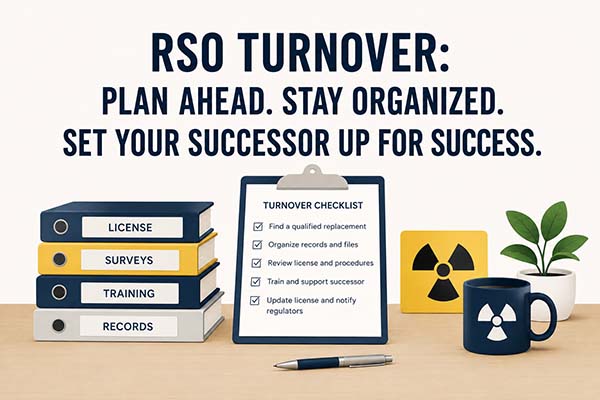
Big-picture – you need to find a qualified replacement, get your program in order, and show your replacement how it all works. But, of course, each of these steps can have some complexities, so let’s go through them one at a time.
Finding a qualified replacement
With several months to go, it’s not a bad idea to tell your employer they’re going to need to find a new RSO. And I know it’s not always that easy, especially if your employer has a habit of letting someone go as soon as they turn in their notice. But if possible, it’s a nice courtesy – and it’s the responsible thing to do – to give your employer enough time to at least start to look for a replacement before you’re on your way out the door.
If there’s one of your coworkers who’s been giving you a hand, who’s one of your radiation workers, who’s got experience working with radiation and radioactivity, or who simply seems interested and responsible then you might be able to find a replacement without having to hire someone from outside the organization. If there’s nobody like that within your organization then you might need to post the position and look outside your organization. But whether your replacement is already working for the company or needs to be found and hired they’re going to need to approved by your regulators, and that means meeting whatever requirements they’ve put out – either in state regs or in the NRC’s NUREG 1556.
The big thing is that, for most licenses, NUREG 1556 is going to recommend an RSO with a scientific or technical degree, preferably with some experience working with radiation and radioactivity. But regardless of the level of education and experience, chances are that your replacement will need to take a 5-day RSO course that goes over the list of topics provided in NUREG 1556 and similar documents provided by many state regulators.
Get your program in order
I’m not sure about you, but I don’t like to stick people with stuff I was too disorganized or too lazy to tackle. It’s partly my sense of professionalism and personal responsibility, partly consideration for my replacement, partly that I’d like my successor to think kindly of me, and partly because radiation safety is a small field and I might need to work with my soon-to-be-former employer and/or regulators sometime in the future. The way I turn over my responsibilities reflects on me, and I’d like the reflection to be a good one.
What this means for you is that you need to go through all of your paperwork to make sure it’s in good shape – all of your surveys are done and documented, you’ve inventoried and leak-tested your sources, that your instruments are all calibrated, you’ve had your dosimeters read, trained your radiation workers (and ancillary workers)…and that you’ve got the paperwork to prove it all. If you’re missing some things, you can’t falsify the records – but you can at least write a short note to file noting which records are missing, to keep from sandbagging your successor.
If time and energy permit, I’d also urge you to clean out the records you don’t need to keep (record retention requirements are usually listed in your regulations) and to organize the rest. And while you’re in a cleaning frenzy, maybe clean and organize your radiation safety work and storage spaces as well. Me? I’ve been RSO at four licensees and each time I’ve tried to leave things in the best shape I can, if only so my successor doesn’t have anything to complain about if I run into them later.
Turn over the radiation safety program
And then somewhere along the line you’ll need to turn over your radiation safety program to your successor. If that lucky person is already working for your employer then turnover will be fairly easy – just schedule time to go through your records, show them what your license looks like and review any interesting license conditions, show them where you keep the paperwork, maybe demonstrate some of the procedures (e.g. how to leak test your sources), and answer whatever questions they have. If your successor is coming from outside your organization…you might need to wait until they start work to go through all of this with them.
Something else you can do – and it shows a bit of class – is to write up the license amendment request asking your regulators to remove your name from your license and replace it with that of the incoming RSO. It’s also nice to make yourself available to answer questions for a time after your departure – you can’t do it indefinitely of course, but a few months will give you a chance to help with any snags or questions that might arise.
And that’s about it! For a small radiation safety program (a few relatively low-activity sources and a few radiation workers) the turnover might only take a few hours to a few days. For a larger and more complex program (hundreds of sources and hundreds of radiation workers) it can take a few days to several days. But doing a proper turnover is a great way to have a clear conscience and to know that you did your best to set up your successor to do well.