

Dump it in the ocean!
Doc, I read something recently that really gives me pause. I know that there are a lot of people and a lot of news stories that show radiation as being so much worse than it really is, but this one’s saying that there are over 200,000 leaking barrels of radioactive waste on the Atlantic seafloor – it’s hard to see this as anything other than bad, maybe even catastrophic. What say you?
I say…I need to learn a little more first, so I’ll give the article a read and will be right back.
And – wow – 200,000 is an awful lot of barrels, isn’t it, especially with a lot of them leaking. But rather than making a guess, first let’s take a little closer look to see if there’s any additional information…and maybe a bit of history.
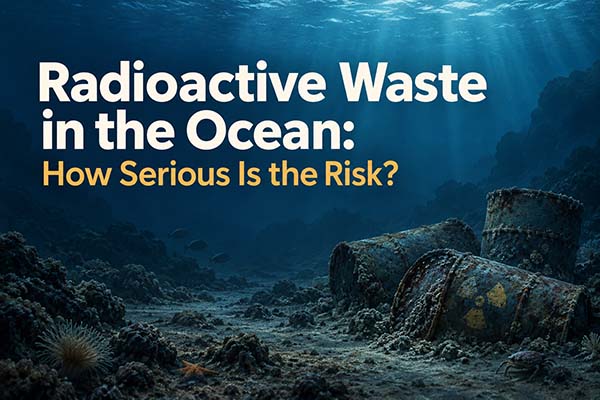
The history part is that (clearly) radioactive waste – and a lot of other hazardous materials – used to be disposed of by packing it into barrels and dumping it overboard into the sea; the barrels would sink through a few miles of seawater, coming to rest in the seafloor sediments. Part of the thinking was that, in the oxygen-starved water at those depths, the barrels would simply sit there without rusting, just as the Titanic and other deep-sea shipwrecks (including several nuclear submarines) have done. Another part of the thinking was that the barrels might hit at a high velocity and simply bury themselves in the muck; since the clay minerals in the muck have a great ability to absorb (and adsorb) contaminants, anything that did leak out (the thinking went) would bind to the mud and wouldn’t migrate very far. And, of course, at the time the deep seafloor was thought to be barren of any life. All of these assumptions have turned out to be false – many of the barrels have corroded and exposed their contents to the sea – and to the sea life on the bottom – and few (if any) barrels buried themselves in the muck. And yet another part of the thinking was along the lines of “The ocean’s so big – no way we can hurt it!”
With more than 200,000 barrels left on the seafloor, it seems the practice continued for some time, but it finally ended in the 1970s – but that was more than a half-century ago, and recent dives have given scientists a chance to take a look to see how these old waste disposal sites are faring. It’s a mixed story – on the negative side, many of the barrels are leaking and are literally crawling with sea life; on the positive side, the sea life appears to be thriving (not dying of radiation exposure) and the radioactivity doesn’t seem to be spreading very far from the barrels due to glomming onto the clays in the seafloor sediments; a property of clay minerals technically known as their cation exchange capacity. Incidentally, the sediments in the vicinity of two sunken American nuclear submarines show the same pattern – even where radioactivity was found it was apparently limited to sediments close to the vessels.
Nuclides found include many that are formed in nuclear reactors, Co-60, Cs-137, Am-241, are the best-known, but Nb-94 has been identified as well. In addition to being formed in nuclear reactors and found in spent fuel, these are also similar in having relatively long half-lives – from Co-60’s 5.27 years to 23,000 years for Nb-94.
And that’s about it for this one. Lots or barrels of radioactive waste sunk at sea; sediments absorbing and apparently stabilizing the radionuclides, and the sediments helping keep contaminants from spreading too widely…even those with long half-lives.