

Doc! I’ve been reading stories about these new small reactors and one thing I’m not quite sure I understand is when they mention the different kinds of fuel. I read one story about something called HALEU fuel, then there’s TRISO and prismatic fuel…and what’s with the homogeneous fuel…and MOX!? Gotta admit it’s sort of confusing.
“Traditional” reactor fuel
Most of the world’s nuclear power plants and military reactors are water-cooled plants that run on fuel consisting of enriched uranium oxide fuel pellets that are clad with a corrosion-resistant zirconium alloy and stacked inside a zirconium alloy tube to form a fuel rod. A number of fuel rods are arranged into a fuel assembly and fuel assemblies are arranged to form the reactor core. Atoms produce a great deal of energy when they fission and this energy causes the fuel to heat up – if this heat is allowed to accumulate the fuel can heat up to the melting point; this is prevented by circulating water through the core and then through large heat exchangers (steam generators) to produce the steam that’s used to spin turbines that make electricity or push a ship through the water.
HALEU fuel
Commercial power plants typically run on uranium fuel in which the concentration of the fissionable U-235 has been enriched from the normal 0.72% found in natural uranium deposits to a concentration that will sustain a fission chain reaction – about 3%-6% U-235. Low-enriched uranium (abbreviated LEU) is less expensive than uranium at higher enrichments, but it also needs to be replaced when power production burns out the U-235 and the now-spent fuel requires replacement. Plus, a low fuel enrichment means that there aren’t many fissile atoms in any given volume of the core, producing a relatively low amount of energy per unit volume in the core. It’s hard to make a powerful reactor core that fits into a compact footprint using regular LEU…enter HALEU!
HALEU stands for high-assay low-enriched uranium; uranium that’s been enriched to the highest level that’s still considered to be LEU – 20% U-235. The higher uranium enrichment means that the same volume of core will produce more energy and can go a longer time between refuelings. If someone wants to pack five or ten megawatts into a reactor that will fit inside a cargo container, chances are that it’ll be fueled with HALEU.
TRISO fuels
If metal is heated to a high enough temperature it will melt – uranium, zirconium, steel, and other metals will all melt if heated sufficiently. And since the fuel and clad contain not only the fuel pellets, but also the radioactive fission products, if the fuel melts down all of that radioactivity can be released into the environment. This is where TRISO (Tri-structural, Isotropic) fuel can come in handy.
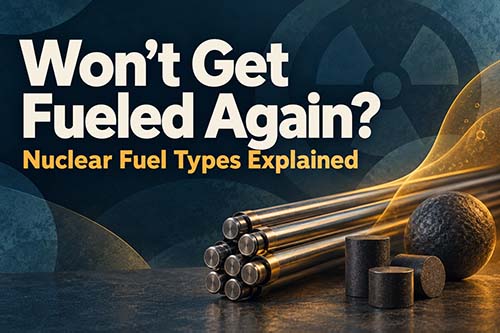
TRISO particles are about the size of a poppyseed; within that tiny volume there’s a small kernel of uranium coated with three layers of protection, including temperature-resistant graphite. The particles themselves are not large enough – don’t carry enough uranium – to sustain a critical chain reaction. But when hundreds or thousands are arranged in layers inside a graphite sphere about the size of a softball, tossing a bunch of those spheres into the hopper of a pebble-bed reactor will assemble a critical mass that’s in a geometry that will achieve criticality. But the kernels can also be arranged inside a larger block (prism) of graphite, a number of which can be assembled into a reactor with prismatic fuel. And with a melting point well in excess of 3000° C, graphite is virtually meltdown-proof.
MOX fuel
I’ve written about MOX already, but that was a decade ago, so I can understand if you’ve forgotten. The key thing about MOX is that it mixes oxides of both plutonium (which is produced by neutron capture by U-238) with the oxides of uranium. The problem with MOX fuel is that the plutonium can only be obtained by reprocessing spent reactor fuel, which isn’t being done in the US at the moment. What’s nice about MOX is that it destroys the plutonium produced in every reactor core, and makes it possible to get energy out of spent fuel.
Homogeneous fuels
And that brings us to the intriguingly named homogeneous fuel, used in molten salt reactors. This is an elegant system in which the fuel is dissolved into molten salt used to transfer heat from fission to the medium (usually water) that does all the work – as the fuel/coolant (fuelant?) circulates through the reactor plant it’s usually traveling through pipes, in which neutrons escape through the sides without causing fission (a critical mass that lacks critical geometry). But when coolant enters the reactor tank a critical mass can accumulate in a geometry in which neutrons from fission are likely to be captured by a U-235 atom to cause another fission. In this case, criticality is determined by the geometry of the various parts of the cooling system. There’s a lot to like about this type of fuel, starting with the fact that it’s already liquid, so a meltdown is sort of out of the question. And, unlike the water-cooled reactors, molten salt can deliver very high (and thermally efficient) temperatures while remaining at atmospheric pressure, which put much less strain on the fluid systems. You can read more about some of the good bad for these sorts of reactors in a piece I wrote a few years ago.
I hope this answers your question without adding to the confusion. The bottom line is that there are a bunch of types of reactor fuel that promise to be safer than what we’re using in the conventional water-cooled reactors.