

Overview:
One day at the office a past client called up with a problem; they were replacing the refractory brick in one of their furnaces and the dumpster with the old brick was rejected by the construction landfill when the load of brick set off their radiation alarms. Not being sure if they really had radioactive bricks or if it was a mistake, they decided to leave the dumpster in the parking lot and gave us a call.
The main problems:
The company wanted to know a few things about their bricks:
- Were they really radioactive and, if so, why?
- Were they regulated or required to be disposed of as radioactive waste?
- Was there any risk to their employees?
- What did they need to do in the short and long term?
The solution:
First thing we did was to get the details about the bricks from the client; in particular, what were they made of? After that, we needed to make some measurements. Once we had that information we could figure out where to go from there.
Looking at the Safety Data Sheet we saw that the bricks were made from a mixture of alumina, silica, and zirconia – it’s the last one that might have been the source of the problems. The thing is, zirconium is a rare earth element, geochemically very similar to uranium and thorium. As such, any mineral with zirconium is likely to contain uranium and thorium as contaminants. This was confirmed by the SDS, which stated that U and Th could be present, but assured the reader that their concentrations would be lower than one twentieth of one percent by weight; this put it in the category of an “unimportant quantity of source material” and, as such, exempt from regulation. We’ll get back to this last point in a bit.
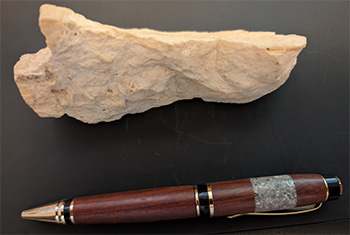
The other thing we did right away was to put instruments on the brick to confirm it really was radioactive, that the landfill’s instruments were working properly (we also sent a chunk off for laboratory analysis). And when we measured the dumpster there was no doubt that the brick was a tad hot – about 5 to 10 times as high as the background radiation levels. On the other hand, rad levels were far below the 2 mR/hr that would have called for establishing radiation boundaries, which was good. In any event, our readings and the SDS were enough to get us started.
Our work thus far had shown:
- that the brick didn’t pose a risk to workers,
- it was exempt from regulation,
- it didn’t need to be treated as radioactive waste,
- that the client didn’t need to have a radioactive materials license, and
- that there was no need for a radiation safety program.
After this, we asked to hold a meeting with the staff to tell them why this brick was not a health risk (unless they created a lot of dust to inhale) and to answer any questions or concerns they might have.
Given all of this, we focused on working with state regulators (NORM – naturally occurring radioactive materials – is primarily regulated by state governments) and on convincing the landfill to accept the waste.
Additional snags along the way:
The fundamental snag turned out to be the state government. Our painstaking analysis of the relevant state and federal regulations made it clear that the refractory brick was exempt from federal regulation, and that the state regs didn’t apply. In spite of that, the state official serving as their lead adamantly insisted that it was radioactive waste that could only be disposed of into a radioactive waste disposal site, refusing to discuss the relevant regulations and turning down all suggestions to meet to talk about the matter.
Given the state’s stance, the landfill continued refusing to accept the bricks and our client settled in for the long haul, retaining an attorney specializing in environmental law. At this point my work changed from radiation safety to working with the attorney to try to make the exempt status of the refractory brick clear, even to the stubborn and misinformed state official who continued insisting that unregulated refractory brick was really radioactive waste.
And the final resolution!
This one took a few years longer to resolve than expected, largely due to the intransigence of the state’s radiological regulatory folks, who continued not talking with us. Ultimately we had to go over their head to the state legislature to request adding a new line to state regs, explicitly stating that refractory brick was exempt from regulation, provided it contained less than one-twentieth of one percent source material (uranium or thorium) by weight. Once that was passed into law and went into effect the landfill allowed disposal of the refractory brick.
It seems like an awful lot of work and expense to get rid of several tons of bricks and, in fact, the client could probably have just found a construction landfill without radiation detectors for disposal. On the other hand, had the state regulators found out it only would have caused more problems. More importantly, an increasing number of landfills were installing radiation detectors and the client foresaw having to search harder and harder to find a place willing to accept their waste. In the long run, adding a specific exemption to the regs was a better fix.