

Overview
I was contacted by a former client who had used thorium in their industrial process several decades earlier. Seems they wanted to sell one of their former manufacturing sites, but it was a location where the thorium had been used and they were concerned it might be contaminated. They wanted the site to be characterized and, if necessary, remediated. I hurried to put together a cost and work estimate, which they accepted. I had to write up a survey plan and sampling plan and submit it to the state environmental regulators (Th-232 is naturally occurring radioactive material – NORM – which is regulated by states), pick up some instruments and probes, and we were ready to start work in mid-September.
The main problem(s)
My client knew that thorium had been used at their facility, but the former process building had been torn down, leaving only an outline of the foundation and partial slab, some buried tanks and pipes, and stray bricks and pieces of concrete. Before we could develop a remediation plan we needed to develop a site characterization plan, including soil sampling, to submit to state regulators for review and comment. It took a few iterations to satisfy them, and then it was time to start to work.
After characterization, we needed to come up with a plan to remove and dispose of whatever thorium contamination we found; that called for a remediation plan that, again, needed to be negotiated with the state regulators.
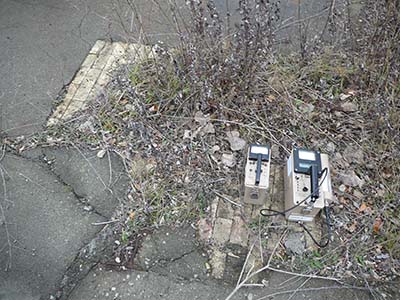
Figure 1: Measuring a hot spot
The solution
I characterized the site by making dose rate (with a pressurized ionization chamber) and count rate (using a 2”x2” sodium iodide detector) measurements on a 10-m grid, using a finer (1-m) grid around the tanks and the locations of the former loading docks. I was also able to trace the paths of underground pipes connecting the tanks as they were hot enough to detect from the surface. The surveys confirmed that contamination was limited to the suspected locations, so I took soil samples in each of these areas as well as some locations chosen at random and shipped to a commercial lab for gamma spectroscopy.
Additional snags along the way
Snag #1: Although the mapping came out about as expected, some of the soil samples threw us a curve. Specifically, they showed elevated levels of Ra-226; the same isotope used in self-luminous (glow-in-the-dark) products until about 50 years ago. The first thing I did was to ask the lab to run alpha spectroscopy analyses on the soil samples, looking for isotopes of uranium, thorium, and radium – not a decision I made lightly because of the expense of alpha spec. While those analyses were being run, I started looking into the history of various lots in that area. And luckily the results of both of these lines of inquiry supported each other! It turned out that, about a century earlier, a coal gasification plant had been on an adjacent lot – there’s a well-understood association of uranium with fossil fuels. And since various radium isotopes are formed by the decay of uranium and thorium, this meant it was possible that the Ra-226 was from uranium in the coal that had drifted over from the coal gasification plant.
What the lab report showed was U-238 and its decay series isotopes that were present in roughly equal activity concentrations – a condition known as secular equilibrium. This is characteristic of natural materials, and it supported the premise that the Ra-226 originated in the coal gasification plant and settled out on my client’s property. The state regulators agreed with this assessment and that the amounts of Ra-226 and other decay products were too low to require either licensing or remediation. Whew!
Snag #2: Although I’d strongly advised finding a remediation contractor with experience removing radioactive contamination, the client’s project manager retained a firm that they had previously worked with, noting that the contractor had always done good work at reasonable rates.
The contractor used a backhoe to dig out around the tanks to be removed, ending up with a pit about 6-8 feet deep. They then used the backhoe to lift out the first tank, placing it onto a tarp, then attached straps to lift the second tank…the tank broke, releasing a gray sludge onto the soil. The sludge contained, among other things, some of the thorium that my client had used decades earlier. Cleaning the residual sludge from the remnants of the tank so it could be removed took some time, as did cleaning up the sludge and contaminated soil. The initial 2-day plan slipped, now taking most of the week.
Snag #3: The best way to convince a regulator that all of the radioactivity has been cleaned up is to make some measurements and show that dose rate and count rate have gone back to normal; as the sludge cleanup progressed, I started entering the pit to measure count and dose rates. So imagine my disappointment when the count rate and dose rate inside the pit were twice as high as when I was standing on uncontaminated ground outside the pit. And here’s the thing – we’d cleaned up all the sludge and sludgy soil, the tanks were sitting on a tarp about 50 yards away, and there was no way there could be that much contamination in what looked like undisturbed (well…except for our recent work) soil. Yet the readings were clearly elevated and the regulators weren’t about to release the area. It was getting on towards noon so we agreed to break for a few hours over lunch. Everyone else headed to a nearby sandwich shop but I’d brought my lunch – as I ate I started thinking about what was going on.
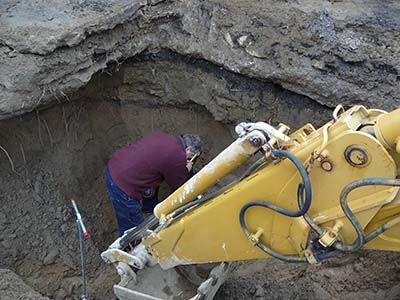
Figure 2: Making measurements in the wall of the pit
It occurred to me that when I was standing outside the pit radiation from the natural radioactivity was only entering my detector from one direction – from the ground I was standing on. On the other hand, when I was standing in the pit, radiation was entering the detector from the sides as well – in fact, from five of the size “sides” of an imaginary box. Which means that the same concentration of radioactivity would be expected to produce higher count and dose rates when I was standing in the pit even in the absence of any residual contamination at all. But how to demonstrate that to the regulator’s satisfaction?
Looking at my watch I was there was over an hour left for lunch so I took a quick drive to a local hardware store and bought a six-foot length of 3” PVC pipe. I had a hand auger in the trunk of my car and, when I got back to the site I augered a hole in the side of the pit to a depth certain to be beyond any potential contamination, inserted the piece of PVC pipe, and made radiation measurements every 6” from the side of the pit to the end of the pipe. The readings were virtually identical along the length of pipe, and also matched the readings in the pit, including standing right where the sludge had spilled and been removed. I augered additional holes and made additional measurements, all showing the same thing. When the regulators returned I repeated the demonstration to them and explained my reasoning – they agreed and we put that issue in the “resolved” pile.
Snag #4: We loaded two trucks with containers filled with remediation waste, completed the relevant papers, placarded the truck, and the contractor contacted their normal construction waste landfill to arrange for delivery. The landfill wouldn’t take it because of the thorium. They called another landfill – which also refused to accept the waste. The client tried some hazardous waste landfills (more expensive than construction waste, apparently, but not as bad as radioactive waste sites) but they, too, refused to accept the material. I joined a few of the calls, explaining that the waste was below any limits for thorium contamination – that it was not considered to be radioactive waste. Nobody cared.
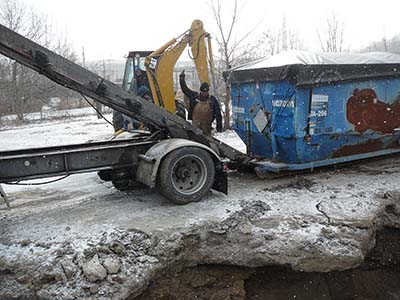
As one landfill put it, “We know it’s legal for us to let you bring it here; the problem is that our permit’s coming up for renewal and we’re gonna have to have some public meetings. All it takes is one person who went through our records and sees we accepted some thorium and the meeting turns into why we’re taking radioactive waste. We don’t want that.”
We couldn’t get around this one – the contractor finally had to take it to a radioactive waste disposal site, paying substantially more than the other options would have cost. That’s the point at which the client’s PM told me “Should have followed your advice…we just didn’t know it’d be like this.”
The final resolution
Ultimately the site was cleaned up, released by the regulators for unrestricted use, and sold. The waste was disposed of as mentioned earlier, and everyone was happy. And a few years later the client called me back for some more work.